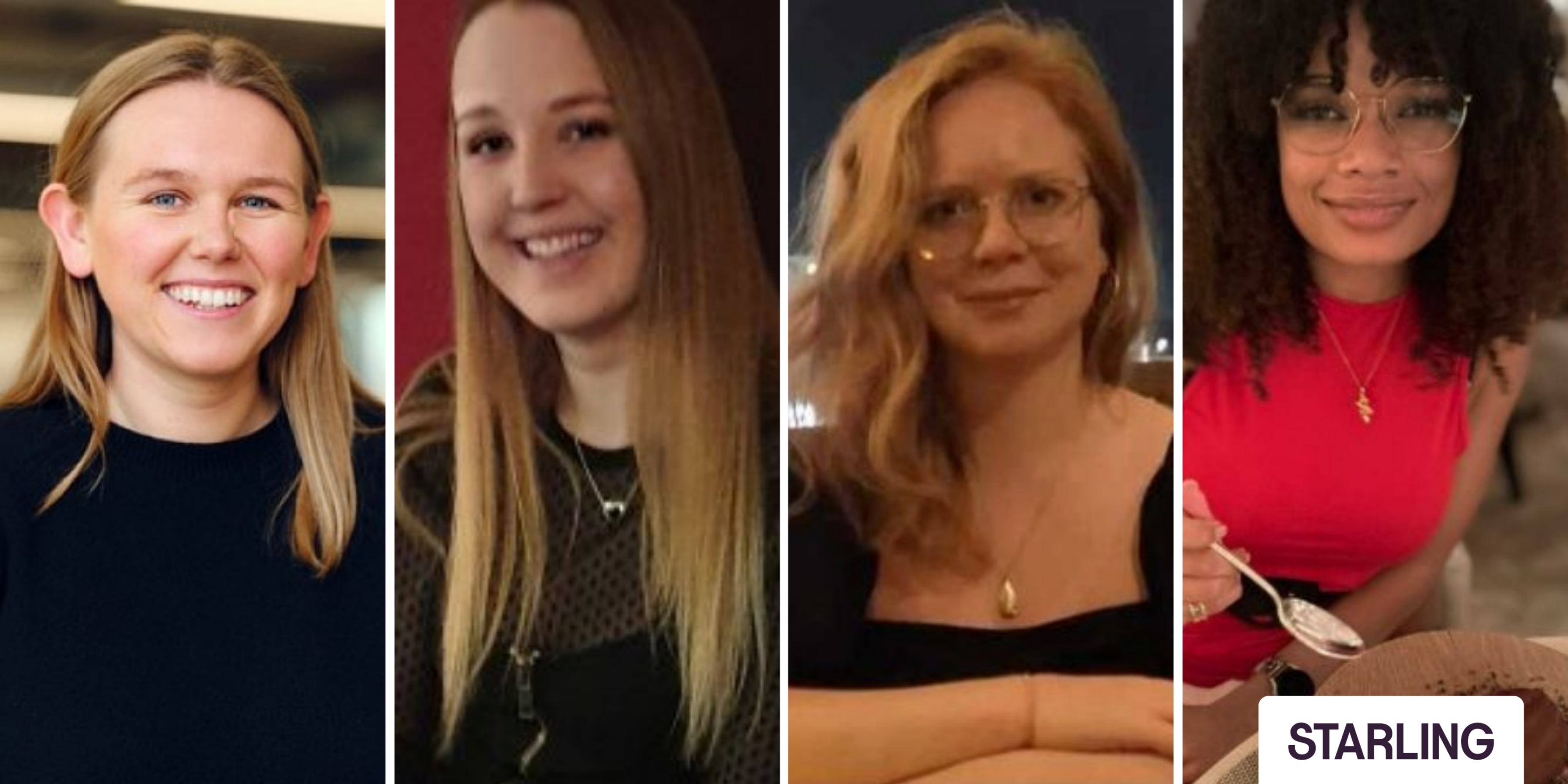
At Starling Bank, diversity and innovation go hand in hand. As we continue to push boundaries in the world of banking technology, it’s important to recognise the incredible women who are playing an integral role in shaping the future of our industry. In this special feature, we spotlight four women from different backgrounds and with unique career journeys, all united by their passion for technology and their drive to make a difference.
From tackling cyber threats to enhancing customer service efficiency, each of these women has made her mark at Starling Bank. Join us as we dive into their individual stories, uncovering their paths into tech, the challenges they’ve faced, and their invaluable advice for the next generation of women in the industry.

Millie Norton’s journey into the world of cyber security was sparked by a love of mathematics and a fascination with computer science. As a Triage Analyst at Starling’s Security Operations Centre, Millie’s role involves proactively identifying and responding to cyber threats to safeguard the bank’s systems and protect customer data. Whether she’s investigating phishing emails or monitoring suspicious login activity, Millie’s job is crucial to ensuring that Starling maintains its reputation for secure banking.
“Technology is for everyone, and women have a crucial role to play in shaping its future. It’s important to break the stereotype that tech is only for men and encourage young women to explore these fields.”
Millie’s path into tech wasn’t straightforward. She found her passion for computer science later than others, having initially studied mathematics, which had always been her favourite subject. It was the biography of Steve Jobs that began her interest in tech. After attending courses in computer science and information security, Millie went on to complete a Master’s in Information Security at UCL, where she honed her technical skills.
While there have been strides in recent years to increase diversity in tech, Millie still sees a lack of women in her field, particularly in cyber security. She believes more needs to be done to address the barriers women face, including societal stereotypes, unconscious bias in hiring, and the lack of exposure to tech careers at an early age.
“We need more female role models in this industry, more mentorship programmes, and more scholarships for women to make tech careers more accessible.”
For Millie, the advice is simple but powerful: “Be confident, be inquisitive, and don’t let anything stop you from pursuing your passion in tech. There will always be obstacles, but resilience and curiosity will help you overcome them.”

Louise Hey’s entry into technology was marked by a love for coding and problem-solving. As a software engineer on Starling’s customer service efficiency engineering team, Louise is responsible for developing features that improve the efficiency and effectiveness of customer service agents, ultimately leading to a better experience for Starling’s customers. Whether she’s working on backend systems or designing user-friendly front-end tools, Louise is driven by the impact her work has on real people.
“Exposure to technical skills at an early age is key. We need to show young women that they can excel in tech, just like anyone else.”
Despite not studying computer science at university, Louise found her way into tech through a course with Code First Girls, an initiative designed to get more women into the tech industry. This hands-on experience with coding sparked her interest in the field, and she soon joined a software consultancy in Newcastle as a graduate developer. After four years, she became a senior developer before joining Starling.
While Louise acknowledges the progress in increasing the number of women in tech, she’s quick to point out that there’s still a long way to go. Unconscious bias, especially around the perception that women aren’t as “techy” as their male counterparts, continues to be a barrier.
“The more women we have in tech, the more we normalise the idea that it’s for everyone. But we have to work hard to ensure that these biases are addressed head-on.”
Louise believes that initiatives like Code First Girls are vital for creating access to technical skills, particularly for those without traditional computer science backgrounds.
“We need to encourage women to see tech as a viable career option, regardless of their background or whether they’ve followed the traditional computer science route.”
Her advice to young women is to “trust in your abilities and not let imposter syndrome hold you back. Confidence grows with experience, so surround yourself with supportive mentors and peers.”

Claire Smith made a bold career switch into tech, moving from a background in supply chain management to software engineering. Now working on Starling’s Financial Crime team, Claire helps build and enhance customer screening processes. Her role involves a mix of frontend and backend development, and Claire thrives on the variety of tasks it presents, all while contributing to the bank’s commitment to tackling financial crime.
“There’s no single path into tech. Many women are switching careers and bringing valuable skills from other industries.”
After completing a 12-week bootcamp at General Assembly, Claire began her career as a software engineer and also volunteered as a teaching assistant for General Assembly and other organisations like Code First Girls. This experience helped her gain confidence in her new career while also giving back to the community by teaching others to code.
Though Claire has witnessed progress in terms of access to education and job opportunities, she still sees unconscious bias as a barrier for women in tech. “We need to break down the idea that women have to work twice as hard to prove their worth. The industry is gradually becoming more inclusive, but we need to make sure that women feel confident and empowered to progress.”
Claire’s advice for those considering a career switch into tech is to “hear more stories of women who have successfully transitioned into tech. Tech is such a broad field that there is space for everyone, and your previous experiences are more valuable than you might think.”

Adrienne Clark-McGuire’s childhood fascination with games like Minecraft and Sims led her to a successful career in full stack engineering. As a full stack engineer at Starling, Adrienne writes both backend and frontend code, ensuring that systems are secure, maintainable, and user-friendly. Adrienne thrives on the problem-solving nature of her work and enjoys translating complex user needs into functional systems.
“Technology offers so much flexibility, from being able to work remotely to the vast array of career options it provides. Tech isn’t just about coding—it’s about finding solutions and being creative.”
Adrienne’s path to tech wasn’t linear. She earned her Computer Science degree through a degree apprenticeship with Goldman Sachs, which gave her valuable on-the-job experience. From there, she transitioned into Starling, where she now contributes her expertise to build innovative systems that meet the bank’s needs.
Adrienne sees the biggest barrier for women in tech as the stereotype that tech is exclusively for men. While this mindset is slowly changing, she believes more work is needed to make the field truly inclusive.
“I’ve met so many women who would have loved to pursue tech but didn’t think it was an option for them. We need to make sure everyone knows that tech is open to anyone with the passion and drive to succeed.”
Her advice to young women entering the field is “don’t limit yourself by thinking technology is only coding. There’s a lot more to tech, from project management to data analysis, and there’s always room for creative problem solvers.”
These women are not just filling roles, they are transforming the tech landscape at Starling Bank. As they continue to break down barriers, they serve as inspiration for women everywhere to pursue careers in technology, regardless of background or experience. Starling Bank remains committed to supporting diversity, offering mentorship, and fostering an environment where everyone can thrive.
By celebrating the achievements of women like Millie, Louise, Claire, and Adrienne, we hope to inspire more women to take the leap into tech and join the growing community of innovators, problem-solvers, and trailblazers shaping the future of banking and beyond.