
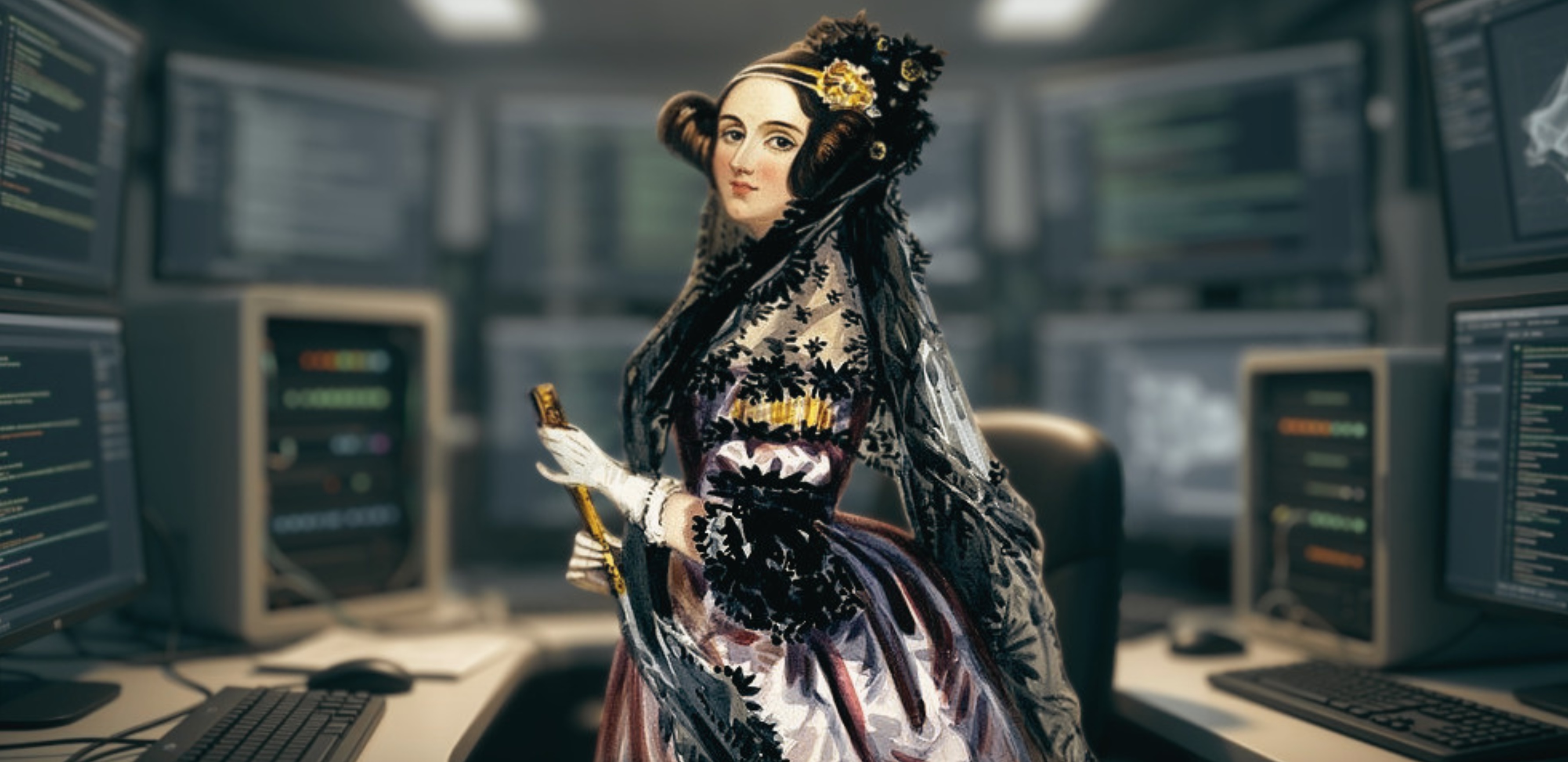
In a world where software powers everything from finance to creative arts, it can be easy to forget that the concept of computer programming existed long before the first electronic circuit was ever flipped. At the heart of computing history stands Ada Lovelace (1815–1852), a mathematician, writer, and visionary whose work laid the groundwork for modern computer science.
Every October, the global tech community celebrates Ada Lovelace Day – an international day dedicated to celebrating the achievements of women in science, technology, engineering, and mathematics (STEM). It is both a tribute to Lovelace’s pioneering genius and a catalyst for expanding gender diversity across the industry today.
Born Augusta Ada Byron, the daughter of the Romantic poet Lord Byron and the mathematically inclined Lady Anne Isabella Milbanke, Ada’s upbringing was unique for a 19th-century woman. Fearing her daughter would inherit her father’s unpredictable poetic temperament, her mother insisted Ada be rigorously tutored in mathematics, logic, and science.
Rather than rejecting poetry, Lovelace combined it with logic, developing what she called “poetical science.” This unique lens allowed her to see possibilities in technology that others missed.
“If you can’t give me poetry, can’t you give me poetical science?” — Ada Lovelace
When Lovelace met mathematician and inventor Charles Babbage in 1833, she became fascinated by his design for the Analytical Engine—a mechanical, general-purpose computer. While Babbage focused primarily on the machine’s ability to crunch numerical tables, Lovelace saw a far broader future.
In 1843, while translating an Italian memoir about the Analytical Engine, Lovelace added extensive notes of her own. In these notes, she published what is widely recognised as the world’s first complex algorithm designed to be executed by a machine—an algorithm for calculating Bernoulli numbers.
Lovelace’s true genius lay in her ability to recognise that computing was not limited purely to mathematics. She famously recognised that if a machine could manipulate numbers, those numbers could represent other entities in the real world—such as musical notes, words, or images.
“The Analytical Engine weaves algebraic patterns, just as the Jacquard loom weaves flowers and leaves.” — Ada Lovelace
“The Analytical Engine might act upon other things besides number, were objects found whose mutual fundamental relations could be expressed by those of the abstract science of operations… the engine might compose elaborate and scientific pieces of music of any degree of complexity or extent.” — Ada Lovelace
Lovelace understood that human creativity was required to guide hardware, famously observing the fundamental relationship between human instruction and machine execution:
“The Analytical Engine has no pretensions whatever to originate anything. It can do whatever we know how to order it to perform.” — Ada Lovelace
Founded in 2009 by Suw Charman-Anderson, Ada Lovelace Day was established to address a persistent challenge in technology: the visibility of women in STEM fields.
While female pioneers have always contributed to scientific and technological breakthroughs, their stories have frequently been sidelined or erased from popular history. Ada Lovelace Day serves three critical goals:
Lovelace’s confidence in her intellectual abilities remains an inspiring reminder to push past systemic boundaries:
“That brain of mine is something more than merely mortal; as time will show.” — Ada Lovelace
Ada Lovelace did not simply write a piece of historical code; she gave us a framework for thinking about technology as an extension of human imagination.
As we navigate new frontiers, from artificial intelligence to quantum computing, Lovelace’s blend of analytical rigor and creative vision is more relevant than ever. By honoring her legacy on Ada Lovelace Day, we reaffirm our commitment to building an inclusive, diverse tech ecosystem where every visionary thinker can thrive.